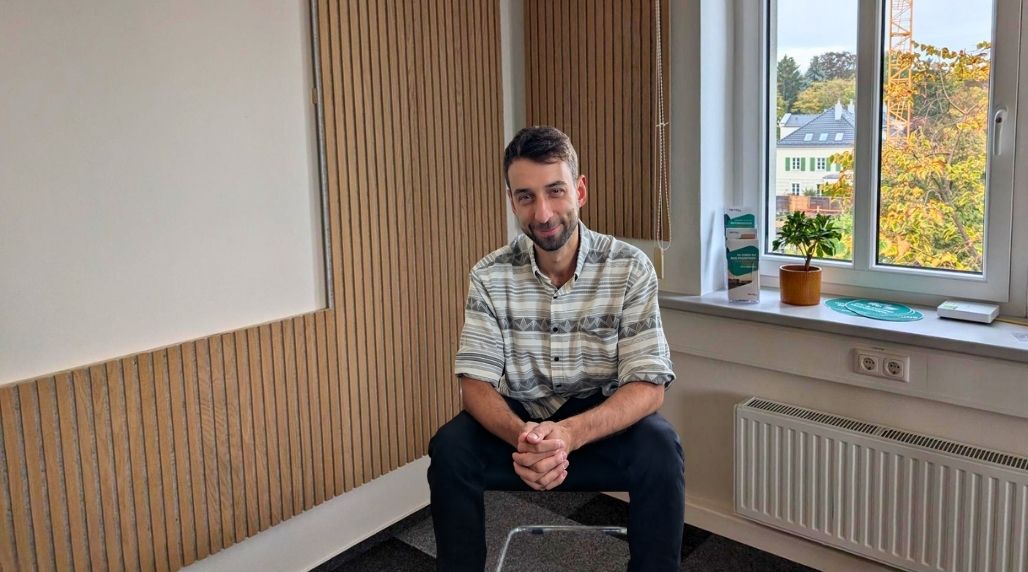
Flo is sitting in the HR office. He just finished coordinating the large-scale office relocation at TRICERA—and had to find a new spot for himself in the process. Now he’s sitting here with me for an “interview.” Let’s see what we can find out about him.
Flo, would it be okay if people called you a know-it-all TRICERA veteran, or do you think that’s a bit of a stretch? It feels like you’ve been around forever.
Now that’s what I call a big question to start with. It sounds a bit over the top to me. I’ll take a systematic approach and break down “know-it-all veteran” into “veteran” and “know-it-all” to simplify things. That seems like a good approach in general.
Veteran: Given that I was one of the lucky ones (?) who was there from the very beginning—setting up desks on Tannenstraße back on Day 1—I suppose you could call me a veteran in that regard. But besides me, that also applies to 18 other people (I just counted again) who are still with the company. Only 8 have left since then. That’s actually a pretty good track record, isn’t it?
Know-it-all: That’s actually harder for me. There are certainly many people at TRICERA who know much more than I do in their respective departments. But I think I have a good overview and practical knowledge that spans across departments. That’s partly because I’ve worked in various departments (SD, RE, PD) and, given my current position, am responsible for ensuring the best possible transfer of knowledge between them. So it’s not that I know more—it’s simply that I know different things, which I use to try to create connections between others’ expert knowledge so that, in the end, it can be applied effectively and efficiently. The two are interdependent; without expert knowledge, my work would be worthless, which is why I don’t find the classification of “knowing a lot” (and thus, implicitly, “knowing less”) to be accurate.
How would you describe your career path to becoming a Strategy & Communications Specialist, and how does that relate to your degree in electrical engineering? Take us along for the ride.
I started at TRICERA in sales, with the task of building up the C&I division. That was completely new territory for me, since before joining TRICERA I had only one year of work experience as a project manager. I learned a lot during that time. Sure, I made plenty of mistakes along the way, but that’s all part of the process.
At the end of 2021, we had signed our first C&I project with Goldbeck—for TOPREGAL in Pasewalk; our very first project aside from the large-scale warehouse for JT. Since we—as we may recognize from today’s situation—didn’t have enough project managers, I had to/was allowed to/wanted to take on this project, which I had negotiated myself, right away.
Everything we did back then was a first—integrating Daimler batteries, installing our in-house-developed CSE, rolling out our own software stack, … And on top of that, there was the connection to the charging network and the PV system, which we had to integrate. We noticed a lot of mistakes, and many things were very “dynamic” because there were hardly any established processes yet. There were major shortcomings, especially in the embedded systems department, where only one person was working at the time.
At the time, I thought to myself: Okay, if even this small project with 200 kWh takes so much time and effort, what’s it going to be like with the big projects that were in the pipeline back then? So, at the time, I tried to draw as many “lessons learned” as possible from the small project, as well as derive insights and structures from it, and establish them company-wide so that we could benefit from them in other areas and avoid making the same mistakes again. This ranged from suggestions regarding human resources to administrative and financial processes, all the way to embedded features—where, from that point on, I spent the next three years working on the further development of our battery management system (BMS) alongside Baumaco and, primarily, Axxellon.
That’s how I got into corporate restructuring, initially without a formal “mandate” for it. At the end of 2022, a group of people—brought together somewhat by chance—gathered to look back on the year and venture a look ahead. There were plenty of ideas, but also plenty of areas needing work. So the meeting was repeated. However, there was neither preparation nor follow-up for these meetings, which meant that much of what was discussed remained just talk. I then took it upon myself to address this—which ultimately led to the creation of the strategy group, which was then continuously developed and formalized.
And so, over time, my responsibilities shifted more and more in that direction, and I think that’s where my time is best spent for the company—there are plenty of challenges. Fortunately, Tim and Lars have supported this shift over time and through many discussions—because the position was never intended to be like this.
So, how does all of this relate to my electrical engineering degree?? I always find it funny how many people are surprised by this or can’t imagine that I studied it. In fact, I was quite the theorist in college and found systems theory, control theory, and electrodynamics extremely fascinating. Even though Hendrik (who I studied with) likes to tease me about it, I set that aside and discovered my greater interest in organization and structural design. At the same time, I think that my technical understanding and the methodical “engineer’s perspective” also help me a lot in what I do now. Technology and organization are two sides of the same coin, and I find it exciting to combine both perspectives and use them to create something.
Can you give us some insight into your responsibilities? What does a Strategy & Communications Specialist do?
I think a lot of people actually ask themselves that question, which surprises me. But okay, from now on I’ll try even harder. Preparing for and following up on various meetings is crucial.
First up is the weekly staff meeting. This often involves talking to department management beforehand to find out what topics are currently important internally and might also be relevant and interesting to a larger group. I also coordinate with Anne on this—for example, to see if there are any upcoming onboarding or offboarding sessions. In addition, there are “Other Topics,” such as company events or general announcements.
Then the strategy session.Here, I hold regular discussions with all team and department leaders about what’s currently going on and where the (most) urgent issues lie. Often, the information from these other discussions helps us resolve issues—sometimes with very little time investment—that frequently stem from misunderstandings or developments that haven’t reached everyone. During the meeting, we cover various topics: updates and discussions on the M&A process, cash flow, guarantees, and the sales pipeline, as well as news from the projects, such as whether there have been any delays. In addition, we usually dedicate a significant portion of the meeting to profitability and how we’re performing relative to our goals. Then there’s HR as a regular agenda item—a cost overview, how recruiting is going for open positions, etc. But we also address fundamental topics such as salary structure and strategic investments.
There is a board meeting every Thursday morning, for which I prepare the agenda based on current developments and the pending items from the previous week. In addition, I prepare materials for the monthly shareholders’ meetings. I work very closely with Anne on personnel matters.
In the end, many topics and events overlap in terms of content, and elements tend to spill over from one to the other. And with so many meetings, there are also a lot of to-dos that need to be completed or tracked.
And I can’t completely avoid “operational issues” after all: time and again, there are cash flow and guarantee issues; Pasewalk is causing problems; and we need to clarify details regarding our first in-house energy storage facility using Audi batteries on the EUREF campus in Berlin.
And I don’t work full-time, after all, so that I’ll have enough time for volunteer work—and so that it doesn’t always have to happen at night. That way, the week goes by pretty quickly.
You follow a vegan lifestyle, sustainability is very important to you, you’re very involved in volunteer work, and you actively help shape your community. You also work for a company that’s committed to actively helping shape a new era in energy. Do you think you’re a role model for others?
That’s really for others to judge. During my studies, I certainly had the good fortune and privilege of having the time to find a great community at the TU Environmental Initiative and to develop a political identity that went beyond my personal life. Even before that, there were already many issues—or rather, ways to improve them—that concerned me, but for which I hadn’t yet found an outlet. At the same time, there was little in the way of personal responsibilities that held me back (family, caregiving, …).
Consistency is important to me. In other words, I try to live by the principle of not preaching one thing and doing another. Of course, I’m sometimes more successful at it than others.
How important is it to work for a company that shares similar goals and values as you do? What does that mean to you?
For me personally, this is of essential importance. After completing my studies—which were heavily influenced by idealism, especially toward the end—I was very reluctant to enter the workforce. Simply because I was concerned that business was hardly compatible with certain principles, particularly those related to sustainability. In that regard, TRICERA was definitely a stroke of luck.
Certainly, in the business world, it’s often a challenge to maintain a balance between personal values and work. But I think this is also something quite constructive—that is, that the two influence each other and that one’s position, attitude, and perspective continue to evolve. That’s why I no longer view it as a given that business, at all levels, cannot be sustainable. But unfortunately, in practice, it often isn’t (yet).
Tell us more about the initiatives you’re involved in or helping to drive forward. For example, what’s input_DD all about?
input_DD has been my “passion project” since 2019. It’s basically a weekly roundup of event recommendations related to sustainability, society, and politics for the coming week. The basic idea is and remains simple: to “match” the many interested people in Dresden on one hand with the great selection of events on the other. After all, my own experience often shows that both sides are often unaware of each other.
And it’s not easy either: the range of offerings and possibilities is enormous. At the same time, information is scattered all over the place—on posters, websites, and social media channels. All in all, we’re bombarded with a veritable deluge of input every single day. With “input,” we want to bring some clarity to all of this: just one post per week, every Sunday, in a tried-and-true, clearly structured format. No frills.
There are now about 10 of us working on the project. And there’s even a branch in Hamburg now! I’d be really happy if we could expand to even more cities in the future—because, for example, we keep getting feedback from people who’ve moved away saying they miss this elsewhere.
Manu from the TRICERA team also contributes to the project in his free time and has recently done a lot to build and launch our digital infrastructure—especially ensuring that, in addition to Telegram, we have our own website and many cool tools that make editorial work much easier.
We recently produced a movie theater ad for a savings bank promotion using a real film set—it was really exciting! A crowdfunding campaign is currently underway to get the ad shown in all Dresden movie theaters starting in early November.
I’m also active with BUND. There, I focus primarily on organizational development and advocate at the local level for sustainable urban development, climate protection, and climate adaptation. We’re just launching a new group here called “Reinventing Dresden,” which focuses on visions for the (urban) society of the future. The discourse has shifted in recent years, and I believe we need new approaches and strategies to shape the future.
And many years ago, I co-founded the nationwide initiative MENSArevolution, where I’m still active today. There’s certainly a lot I could say about that, but I don’t want to go off on a tangent here—I’d be happy if you reached out to me directly if you’re interested or have any questions 🙂
Is there a highlight from your time at TRICERA so far? What are you particularly proud of?
Actually, I’ve always thought company parties were really cool because, away from the daily grind, I keep realizing what great people actually work here—unfortunately, that sense sometimes gets lost in the stress.
And I’m also very proud that, for the first time this year, we’ve carried out our workforce planning and expansion in such a structured and consistent manner—from scenario planning starting in Q3 2025 to the many new hires we’ve made today. That was a major undertaking. Now I really love walking through the office and seeing so many new, motivated people—and knowing that it was truly worth the effort to make this happen, and understanding where these initiatives originally came from.
Were there any challenging times during your time here, and can you give us some specific examples? Things certainly aren’t always rosy.
I’d say it’s never been easy. And when you look at it that way, it’s a huge accomplishment that TRICERA is still around despite the highly volatile market environment and all the political and social ups and downs. The fact that we’ve managed to do this for 5 years and now have close to 100 employees really speaks for itself.
The project—and consequently cash—slump in mid-to-late 2024 was certainly a difficult time. We didn’t recognize the problem early enough. Today, we’re in a much better position in this regard with the teams in AD and CM. There are regular reviews at board meetings, in strategy sessions, and during many one-on-one meetings. For that reason, something like that wouldn’t happen again today. Back then, it was certainly also due to staffing shortages—how that came about and whether it was inevitable are matters that are open to debate in hindsight.
Things definitely got pretty tense at times. I do remember a heated argument—especially right at the start of an HR meeting—with one of our managing directors when we were presenting the results of an HR survey. That wasn’t exactly a shining moment.
The fact is that, in hindsight, the situation and its causes were thoroughly analyzed. That makes me optimistic. Internally, we have a challenging but healthy culture of debate.
Perhaps as a natural follow-up, here’s a question from the staff: What is your stance on opportunism from a purely moral standpoint, and how does economic reality ultimately shape your theoretical perspective? What opportunities might arise from this, and what risks are associated with it?
I think opportunism is the antithesis of morality in our actions. Sometimes we need opportunism to have the courage—or the willingness to take risks—to drive progress, and we need morality to regulate it. Relying solely on one or the other is, I believe, problematic on many levels—whether as an individual, a company, or a society.
Now I can see that our economic system, based on money and returns, structurally encourages opportunism. As a company—and I’m coming to understand this more and more—you often have to make decisions and take actions that, when viewed from the outside, seem wrong at first glance. Unfortunately, we repeatedly find ourselves in difficult situations where our room to maneuver is very limited—and where there are no optimal or morally sound decisions, but often only pragmatic ones.
If we chose collaborations and partnerships based purely on moral grounds, we would quickly find ourselves isolated—meaning we would have hardly any suppliers or customers left, since everyone acts opportunistically. So that can’t be the way to go.
And the thing about morality is that it’s actually quite subjective. What’s moral to me isn’t necessarily moral to you. Or a value that’s very important to me—say, freedom—might be third on your list, perhaps after security.
However, I am firmly convinced that a company still needs a set of values to serve as its social foundation—one that also sets boundaries. And it needs a culture of open discussion about when those boundaries are reached or crossed.
If you had three wishes for a better future, what would they be? What is your biggest wish for TRICERA?
We need to establish the financial framework for additional and larger projects as soon as possible. This would pave the way for further growth and simplify a process that is currently taking up a lot of our time.
From a practical standpoint, it’s important that we grow continuously and sustainably and maintain or expand our position in the battery market by leveraging our broad expertise. This includes not only providing EPC services for project developers and investors but also being recognized as a reliable and capable service partner—for example, for municipal utilities—while continuing to focus on our specialty: the integration of automotive batteries. Even though this isn’t our core business right now, I hope—also from the perspective of the circular economy—that the market for first- and second-life batteries will make a comeback—for example, for active storage as well.
Well, and generally speaking, I think it would be exciting to contribute to the energy transition in other countries as well by bringing stable and effective solutions online.
With all that said, I hope we don’t lose our “identity”—our friendly and welcoming corporate culture.
Finally: Who are you nominating for the next interview and why?
I work closely with Anne, our HR manager, on a daily basis, and I have great respect for her both as a person and as a colleague. I imagine she has quite a bit to share.